
USDC vs USDT: how reserves and risks shape your choice

Senior Exchange Markets Writer
USDC and USDT both target a dollar, but their reserves, reporting and payout routes differ. Compare the trade-offs, the 2023 de-peg and options for Ukrainian card withdrawals.
USDC is a US-dollar stablecoin issued by Circle, which says it is fully backed and redeemable for dollars at a one-to-one ratio. Its reserves, reporting and availability at Ukrainian exchangers differ from those of USDT.
If an employer offers payment in this token, the practical question extends beyond its dollar peg: which network will carry the payment, and which route will turn it into the currency you need?
What backs USDC, and why does it trade near a dollar?
Circle says USDC is backed by reserves and redeemable one-to-one for US dollars. That arrangement supports the dollar peg, although the price available in the market can move away from it.
A stablecoin targets the value of another asset; here, that reference is the US dollar. A token balance remains a cryptoasset balance, so an issuer’s redemption statement and an exchanger’s offer are different things.
Circle lists bank deposits, including deposits at systemically important institutions, overnight reverse Treasury repo and US Treasuries with maturities under three months. Treasuries and repo may sit within the Circle Reserve Fund, a 2a-7 money market fund managed by BlackRock.
For USDC, Circle reports reserves weekly and publishes monthly attestations by a Big Four accounting firm. Reserve composition describes what backs the token; reporting frequency tells you how often the issuer publishes information about that backing.
Circle calls its product “the world’s largest regulated stablecoin.” This is Circle’s own description, not a safety verdict. A regulatory label does not settle which token fits a particular payment or withdrawal.
USDT also targets a one-to-one dollar peg, backed by Tether’s reserves. The guide to USDT explains its role as a dollar-linked token, while its published reserve reports include assets such as bitcoin and gold.
How do USDC and USDT differ in practice?
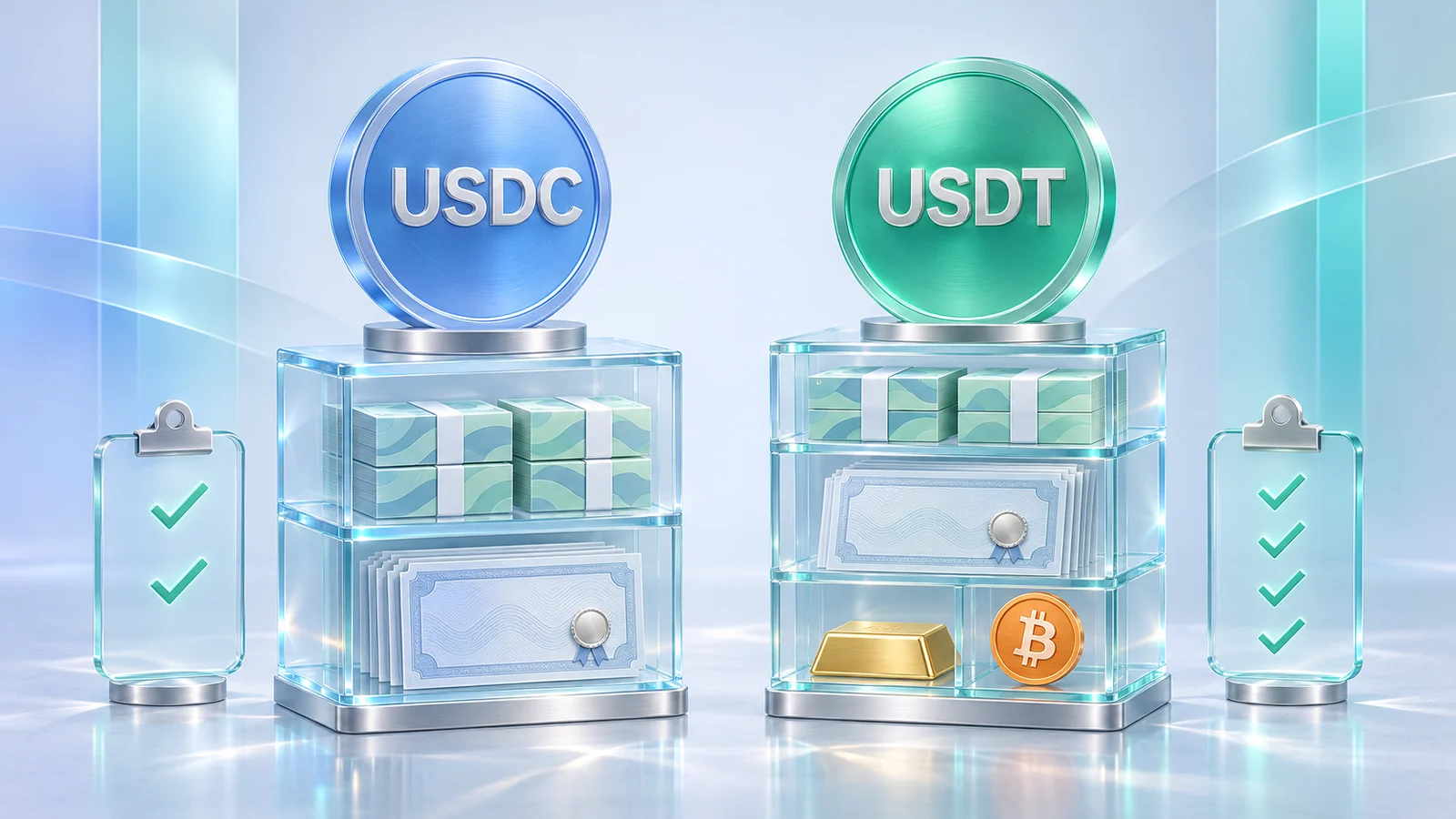
USDC has reserves comprising bank deposits and short-term Treasury instruments, according to Circle; Tether also reports bitcoin and gold. Their reporting schedules and direct redemption arrangements differ, as does availability at Ukrainian exchangers.
| Comparison | USDC | USDT |
|---|---|---|
| Issuer and history | Circle | Tether (Tether Operations, S.A. de C.V.), issuing USDT since 2014 |
| Reserve assets | Bank deposits, overnight reverse Treasury repo and US Treasuries under three months | Tether’s reserves; the issuer also reports bitcoin and gold |
| Reporting frequency | Weekly reserve reporting and monthly attestations | Circulation data typically daily; reserve reports quarterly |
| Reserve reporting firm | A Big Four accounting firm | BDO Italia |
| Direct redemption | Circle states one-to-one redemption for US dollars | Verified customers; minimum USD 100,000 |
| Networks listed on OnExchanger | ERC20 on Ethereum, Solana, BEP20 on BNB Smart Chain, Polygon | More network options; TRC20 is the most used locally |
| Local exchanger availability | ERC20 and Solana card payouts; BEP20 routes to Privat24 and Monobank | More directions and wider availability |
Tether’s redemption threshold concerns dealing directly with its issuer. It is not a minimum for an exchanger order, whose limits belong to the particular offer.
What happened to USDC in March 2023?
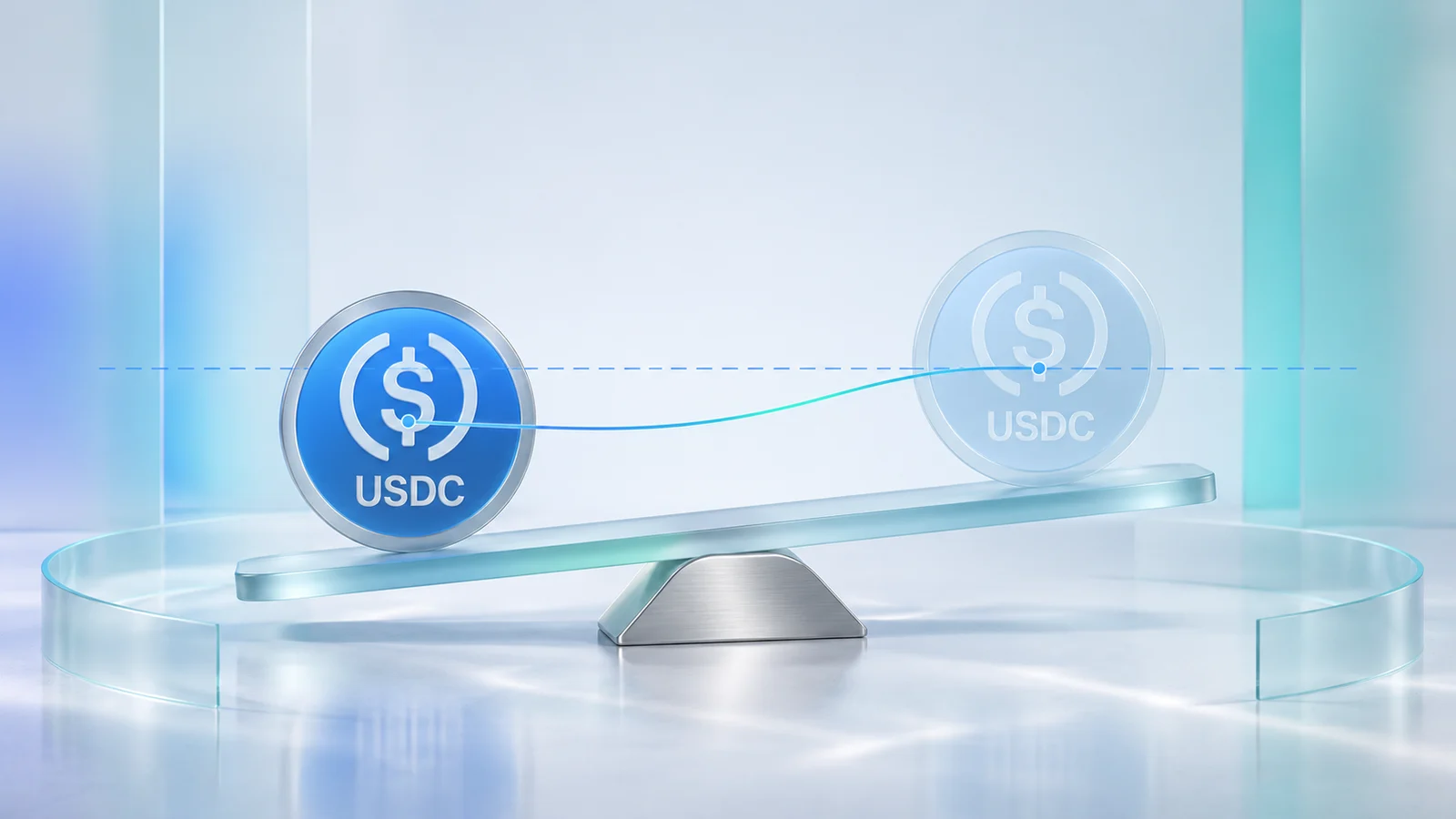
USDC traded noticeably below one dollar for about two days after Silicon Valley Bank failed. Circle had USD 3.3 billion there, approximately 8% of its reserves, making access to that deposit a concern.
On 12 March 2023, the US Treasury and regulators jointly announced that SVB depositors would be made whole. Circle then said the deposit would be fully available, and the de-peg closed.
The event showed that reserve backing and immediate market pricing can diverge. A holder selling during the disruption could face a different dollar value from someone able to wait for the peg to recover.
Hypothetical example, not a live rate: a 2% dip below the dollar peg would value 1,000 USDC at USD 980 instead of USD 1,000, a USD 20 difference before any transaction costs.
The token count in that example stays unchanged; its quoted dollar value falls. These figures illustrate a possible deviation and are not the prices recorded during the March 2023 event.
Should you choose USDC or USDT for a payment?
Choose the route around where the payment will go next, the network accepted there and the issuer reporting you rely on. This is not financial advice.
USDC may fit a payment already offered in a supported network. If you need hryvnias next, compare the amount reaching your card through a direct sale with the amount from a route involving another token.
Both issuers can block addresses. The contents of a reserve report tell you about backing; they do not remove the issuer’s ability to restrict an address.
Network names also affect which offers are relevant. The comparison of USDT networks explains TRC20, ERC20 and BEP20; the current USDT to hryvnia offers provide a reference for a possible alternative payout route.
How can you turn USDC into hryvnias or USDT?
Use an exchanger offer for the network you hold and the payout you need. USDC ERC20 and Solana routes include Ukrainian card payouts, while a swap from USDC Solana can provide USDT TRC20.
OnExchanger.com is an exchanger monitor comparing live rates, payout amounts, limits and reserves before directing readers to an exchanger; it does not hold funds, carry out transactions or perform AML/KYC checks.
The exchanger handles terms, checks and support, while OnExchanger may earn a partner commission without adding anything to the exchanger’s rate paid by the reader.
Available routes depend on the network and destination. The matching pair page contains the live offers table and converter:
- USDC ERC20 to Privat24 for a hryvnia payout.
- USDC Solana to Monobank for that bank’s card route.
- USDC Solana to a Ukrainian card for the general card direction.
- USDC Solana to USDT TRC20 for a token swap.
Compare the amount you will receive for the same input amount, alongside the offer’s limits and reserve. Continue to the exchanger to read its order terms before payment.
Send USDC only through the network named in the order: ERC20, Solana, BEP20 and Polygon are distinct routes.
Buying from a hryvnia card has fewer available offers. For the broader card-to-crypto route, use the guide to buying USDT; your chosen token and network determine which exchanger directions apply.
How do USDC withdrawals, swaps and wallets work?
USDC card withdrawals and token swaps use specific exchanger directions, while wallet support depends on the token’s network.
Is USDC a dollar?
No. It is a dollar-pegged stablecoin issued by Circle, which states that reserves fully back it and that it is redeemable one-to-one for dollars.
Which is safer, USDC or USDT?
Reserve disclosures alone do not establish that either token is safer. Compare what backs each token, how often it is reported and the issuer’s terms.
Can you withdraw USDC to a Privat24 or Monobank card?
Yes. Ukrainian exchangers offer ERC20 and Solana routes to those banks, with BEP20 routes also available; payout amounts and order conditions depend on the selected offer.
How do you swap USDC for USDT?
Choose the corresponding network pair, such as USDC Solana to USDT TRC20. The exchanger’s order specifies the incoming token and network, and the outgoing token and network.
Which wallet supports USDC?
Use a wallet that explicitly supports the token on your selected network. The guide to choosing a USDT wallet explains network-based selection; support for USDT alone does not establish support for Circle’s token.
Sources
Circle’s publications describe its reserves and the March 2023 event; Tether’s FAQ sets out its reserve reporting and direct redemption conditions.
- Circle — USDC
- Circle — Transparency
- Circle — $3.3 Billion of USDC Reserve Risk Removed, Dollar De-peg Closes
- Tether — FAQ
Issuer disclosures concern backing and redemption; the amount paid out through an exchanger comes from its own offer.