
USDT explained: the dollar peg, networks and exchange rates

Senior Exchange Markets Writer
USDT tracks the US dollar and runs on several blockchains. Learn what supports its peg, how networks differ, and how Ukrainians buy it or convert it to hryvnias.
What is USDT? It is Tether’s dollar-pegged stablecoin: a token that exists on several blockchains and is designed to track the US dollar, including when people use it to hold value or settle payments.
What does holding USDT actually mean?
USDT represents a dollar-linked token balance on a blockchain. Tether launched in 2014, and the issuer is Tether Operations, S.A. de C.V.; the label USD₮ refers to the same dollar-pegged token.
The term stablecoin describes the intended price relationship. The reference is one US dollar per token, so the starting point for understanding its value is the peg and the assets supporting it.
There are two separate amounts to keep track of: the number of tokens you hold and the local currency you could receive for them. A balance of USDT does not itself specify a hryvnia payout.
When someone says “keep it in dollars,” they may mean a dollar-pegged token. Ask which asset they mean: holding the token involves Tether as issuer, a blockchain network and a route back to local currency.
How does USDT maintain its dollar peg?
Tether says its tokens are pegged one to one to their matching fiat currency and are fully backed by Tether’s Reserves. For USDT, the reference is one US dollar per token.
The reserves include several asset categories. Tether says it also holds bitcoin and gold as an inflation hedge, so the backing is a portfolio of assets rather than cash dollars alone.
Circulation figures are typically published daily. Reserve reports appear quarterly and are prepared by independent accounting firm BDO Italia under IAASB criteria; reports have broken the reserves down by asset category since June 2021.
Can an individual redeem directly with Tether?
Direct issuance and redemption are available only to verified customers, with a minimum of $100,000. Tether lists a $150 verification fee, a 0.1% acquisition fee, and a redemption fee of $1,000 or 0.1%, whichever is greater.
These minimums and fees apply to direct dealings with the issuer. A retail exchanger sets its own transaction conditions, so Tether’s fee schedule does not tell you what a smaller conversion will cost.
Why does the hryvnia value of USDT change?
The hryvnia value of USDT reflects the dollar’s local value plus a market premium or discount. A one-dollar peg therefore does not fix how many hryvnias you receive for a token.
An exchanger’s rate turns your token balance into a quoted local currency amount. The payout also depends on any applicable charges, which is why the amount receivable matters alongside the headline rate.
Consider a hypothetical example, not a live rate: converting 100 USDT at 40 UAH each gives 4,000 UAH before charges; at 39 UAH, the same balance gives 3,900 UAH.
Use the live USDT to hryvnia rate for current offers and the daily USDT/UAH index for the median of exchanger offers for Privat24 and Monobank. The index describes that group of offers, not a promised payout.
OnExchanger.com is an exchanger monitor comparing live rates, amounts receivable, limits and reserves, then directing readers to exchangers; it holds no funds, conducts no conversions or AML/KYC, and leaves terms, checks and support to the exchanger.
Displayed offers come from exchangers’ public rate data and must have been updated within 30 minutes; OnExchanger may earn a partner commission, while readers pay the exchanger’s rate with nothing added on top.
Which USDT network should you choose?
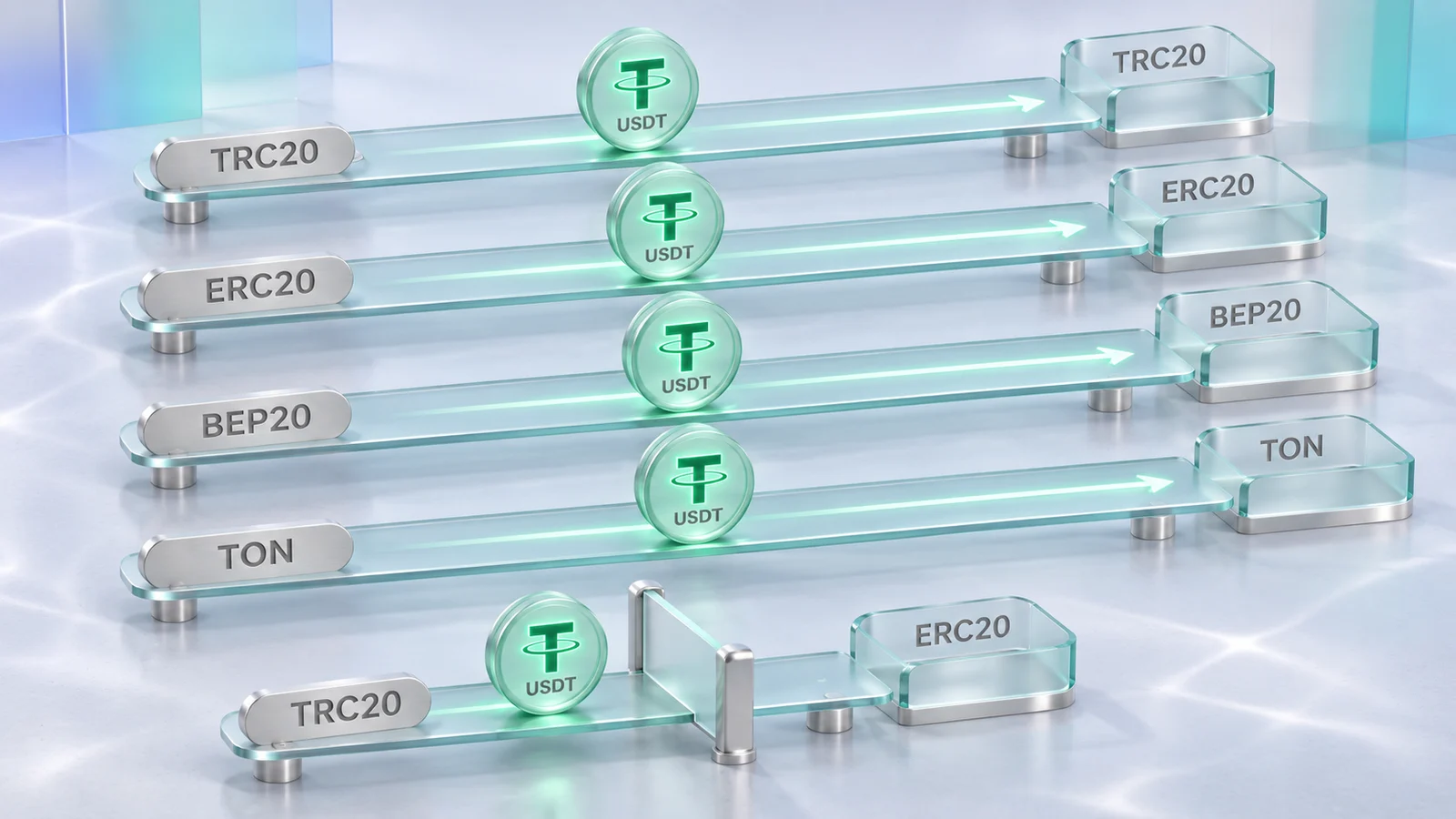
Choose a network supported by both the sending service and the recipient. USDT appears on several blockchains, and the network determines the address format and the asset used to pay its transaction fee.
| Network | Blockchain | Address usually starts with | Network fee paid in | Common uses |
|---|---|---|---|---|
| TRC20 | Tron | T | TRX | Most UAH exchanger directions |
| ERC20 | Ethereum | 0x | ETH | Crypto exchanges and many exchanger directions |
| BEP20 | BNB Smart Chain | 0x | BNB | Crypto exchanges |
| TON | TON | UQ or EQ | TON | Telegram wallets |
Both ERC20 and BEP20 addresses usually begin with 0x, so the prefix alone does not distinguish those networks. For the differences, see the USDT network comparison.
For a USDT transfer, use the same network at both ends: TRC20, ERC20, BEP20 or TON, as specified by the recipient.
What do people in Ukraine use USDT for?
People in Ukraine use USDT as a dollar-pegged unit for savings, payments abroad and conversion to hryvnias through exchangers. Whether a stablecoin suits a particular purpose depends on the route and its conditions.
This guide is not financial advice. Receiving crypto and receiving money on a card are different outcomes, so choose the desired outcome before comparing routes.
- Holding a dollar-linked balance. USDT gives the balance a dollar reference while it remains in token form, rather than completing a conversion to hryvnias.
- Making a payment abroad. An agreed USDT TRC20 payment remains a token transfer; it is different from arranging a dollar payment to a bank account.
- Receiving hryvnias on a card. An exchanger can quote a card payout for your token balance, with the destination and amount determined by the selected direction.
For a future card payout, the relevant comparison is the hryvnia amount receivable. For an agreed USDT TRC20 payment, the relevant amount is the token balance arriving with the recipient.
Proposed changes to crypto taxation in Ukraine appear in draft law 10225-д, which had not been adopted as of 17 November 2026.
How can you buy USDT or sell it for hryvnias?
Individuals generally buy or sell through exchangers, centralized crypto exchanges or P2P at the provider’s rate. See the guide to buying USDT for acquisition routes and crypto withdrawals to Ukrainian cards for payouts.
For live tables and converters, compare UAH card to USDT TRC20 offers or USDT TRC20 to Privat24 offers. The selected direction shows the current rate, amount receivable, limits and reserve.
What risks come with USDT?
The main risks of USDT concern the dollar peg, the issuer’s control over tokens and how a transfer is made. A stablecoin still depends on its issuer maintaining the intended value.
USDT is not a bank deposit and carries no deposit guarantee. The issuer’s legal terms also allow freezes and address blacklisting when required by law or at Tether’s discretion, including cases linked to crime or sanctions.
- Peg risk. The market price can move away from the intended dollar value; the reserve claim and the price offered for a transaction are separate things.
- Network errors. Sending tokens through an incompatible network can put the funds at risk, even when an address resembles the format you expected.
- Phishing. A site pretending to be a familiar service can misdirect a payment; a recognizable name alone does not establish that you are dealing with that service.
A quote answers what a service offers for the transaction; it does not establish the token’s backing or the identity of a website. Use the reserve information and service details for those separate questions.
What does USDT’s dollar peg mean for your balance?
The dollar peg gives a token balance a reference value, while the blockchain identifies where that balance exists. The amount available as hryvnias is set by the quote for the chosen conversion.
Is USDT a dollar?
No. USDT is a token pegged to the US dollar; it is not the fiat currency itself. The issuer describes a one-to-one reference value backed by its reserves.
Can USDT lose value?
Yes. Its market price can move away from the intended dollar peg, and its hryvnia value can also change with the dollar rate and the premium or discount in available offers.
What is USDT TRC20?
USDT TRC20 is the token on the Tron blockchain. Addresses usually start with T, and the network fee is paid in TRX; the TRC20 label identifies the network, rather than a different dollar peg.
Can USDT be frozen?
Yes. Tether’s legal terms allow token freezes and address blacklisting, either when required by law or at its discretion. A blockchain balance therefore remains subject to the issuer’s powers over its tokens.
How much is USDT worth in hryvnias?
The current value depends on the dollar rate and the premium or discount in the offer. Consult the USDT to hryvnia rate for current pricing; your payout is set by the selected offer.
Sources
Tether publishes its description of the peg and reserves, direct customer fees, supported protocols and legal terms. These documents address the issuer’s commitments and conditions, including its powers over tokens.
Tether’s fee schedule applies to direct dealings with the issuer; the terms of a retail conversion belong to the service providing it.